The Fedspeak Tracker scores every FOMC communication — speeches, testimony, interviews, press conferences — on a fixed hawk-to-dove scale, read blind by a language model under a frozen rubric. I think of that as data: a consistent, reproducible reading of the public record. This is the analysis built on top of it — one specific question the data lets us ask cleanly. How did individual policymakers reposition themselves between two distinct chapters of the cycle?
I split the record into two fixed periods:
- 2023–24 — the inflation fight, through the December 2024 meeting.
- 2025–26 — the normalization, from January 2025 through Chair Powell’s final meeting in April 2026.
Chair Warsh’s tenure is left out by construction, since his record is still too short to compare. To keep the comparison honest, the analysis includes only the 14 members who made at least eight scored communications in each period — enough on both sides that a change reflects a genuine shift in tone rather than thin data. That drops members who barely spoke in one window (Hammack, Musalem, Barr, Harker) but keeps those who spoke plenty on both sides even if they later left the Committee (Kugler, Bostic).
Two scales, two very different stories
The single most important thing to hold in mind is the difference between the absolute and the relative scale — and it is where most casual readings of “who’s a hawk” go wrong.
On the absolute scale, this is a dull story: almost everyone eased. As the cutting cycle arrived, ten of the fourteen members sounded more dovish in 2025–26 than they had during the inflation fight. That is exactly what you would expect — the whole Committee moved together with the data.
The relative scale strips out that common tide. It measures each member against the average of everyone else speaking in the same meeting cycle, so it answers a sharper question: as the Committee moved, who moved more, and who moved less? On the relative scale the average change is roughly zero by construction — for every member who broke toward the doves, someone else held firmer and became relatively more hawkish. The redistribution within the Committee is the actual story, and it is not subtle.
The dovish breakaway: Bowman and Waller
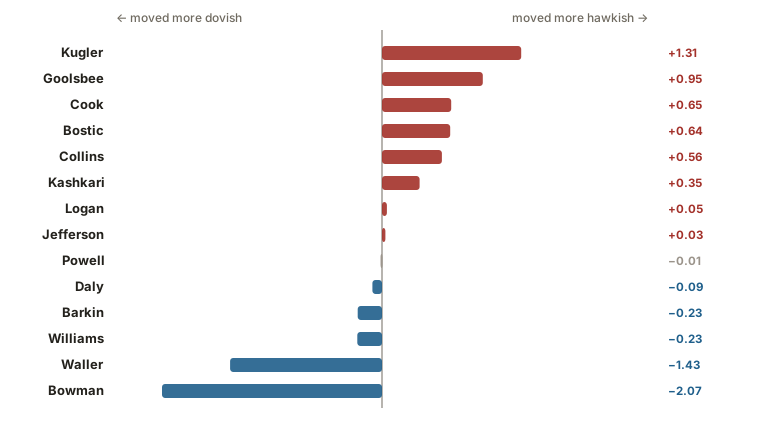
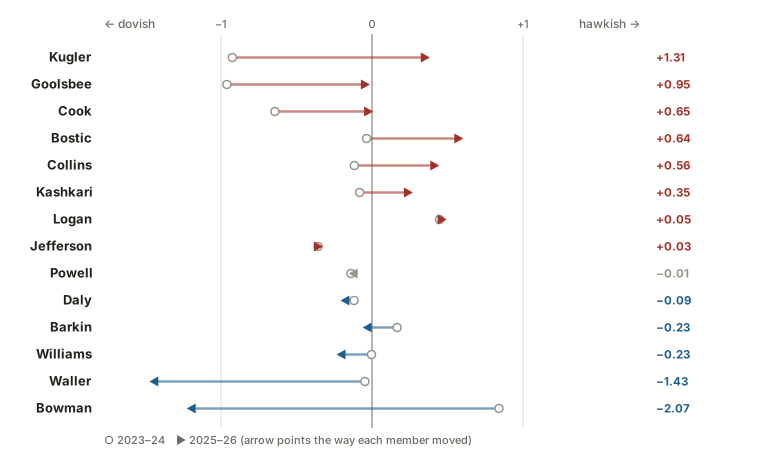
Two Board governors account for the entire dovish tail. Bowman swung the furthest of anyone — a −2.07 move on the relative scale, from clearly hawkish in the inflation fight (+0.84, one of the firmest voices on the Committee) to firmly dovish (−1.23). On the absolute scale the swing is even starker, a full 2.5 points. Waller is close behind at −1.43, going from roughly average for the room to one of its most dovish members.
These are not marginal drifts; they are the two largest moves in the dataset by a wide margin, and they run against the pattern for the rest of the Board. A reasonable reading — and here I’m interpreting, not just reporting — is that this is where the case for earlier, faster easing found its most committed advocates on the Board of Governors as the policy debate and the political environment both turned. Whatever the cause, the tone record is unambiguous about the fact of it.
The relative-hawkish cluster: former doves who held firmer
At the other end sit five members who became relatively more hawkish — not because they turned hawkish in any absolute sense, but because they eased less than the room around them:
- Kugler (+1.31) and Goolsbee (+0.95) top the list. Both had been among the most dovish voices in 2023–24 (−0.93 and −0.96); by 2025–26 they had converged back toward the center, which registers as a hawkish move on the relative scale.
- Cook (+0.65), Bostic (+0.64) and Collins (+0.56) round out the group — a similar story of members who were dovish-to-neutral in the first period and simply didn’t chase the Committee lower.
This is precisely the pattern the relative scale is built to reveal, and it is the opposite of what the absolute numbers suggest in isolation: Kugler, Goolsbee, Cook and Bostic actually sounded a touch more dovish in absolute terms — they just moved less far than everyone else.
The anchors
The middle of the chart is quiet, and that itself is informative. Powell (−0.01), Jefferson (+0.03), Logan (+0.05), Daly (−0.09), and — a little further out — Williams (−0.23) and Barkin (−0.23) barely budged relative to the Committee. Powell in particular held almost exactly the Committee’s center of gravity across both periods, which is roughly what you’d want from a Chair steering by consensus. The dumbbell below shows where each member started and finished, and how far they traveled to get there.
What to make of it — and what not to
A few honest caveats, because a difference-in-differences on a two-year window invites over-reading:
- The scores are model-read, not vote-counted. They measure the tone of what members said in public, on a fixed rubric, not their ballots or their private views. The Tracker’s methods section documents how well that tone tracks real dissents and the dot plot — well, but loosely.
- Relative is a zero-sum lens. By design, someone becoming “more hawkish” here can simply mean the room moved dovish faster than they did. Both charts use the relative scale precisely because that redistribution is the question; read the absolute scale on the Tracker if you want the level.
- The window is fixed and short. It ends at Powell’s last meeting as Chair (April 2026) and excludes Warsh’s tenure entirely. As the new Committee’s record fills in, the interesting comparison becomes the next realignment, not this one.
With those caveats, the picture is clean enough to state plainly: the 2025–26 Committee did not just ease uniformly. It re-sorted, with Bowman and Waller opening up a dovish flank on the Board while a set of former doves quietly became the Committee’s relative center of gravity. That re-sorting — not the average move, which everyone shares — is the part worth watching.